
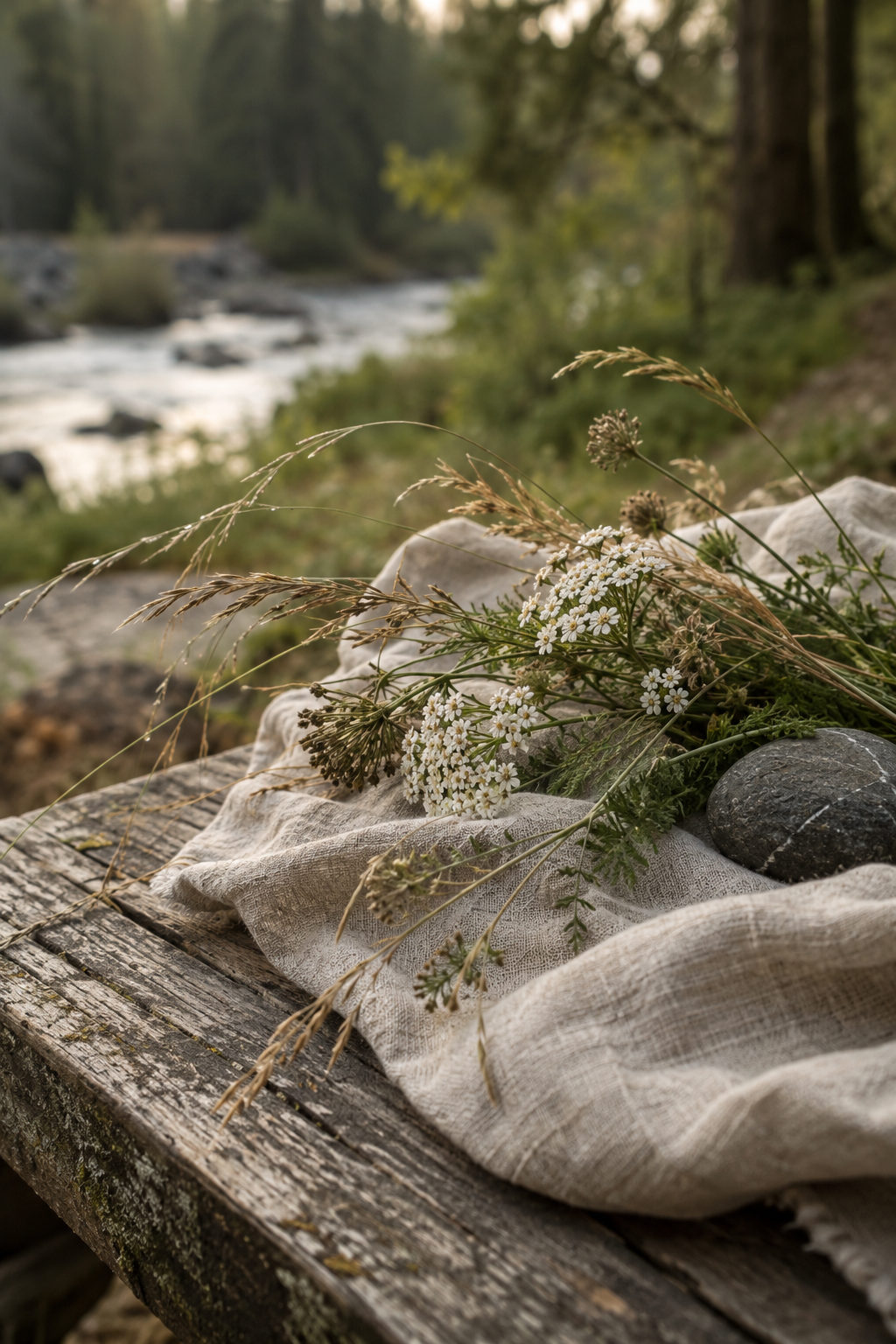
Personal rituals can offer a way to remember and express meaning after loss. A plant, a familiar song, or a quiet moment may become part of life alongside medical care, grief counseling, and community.
Some things need a place to go
There are moments when words feel too small for what we are carrying.
A flower on the table. A song played on an ordinary morning. A walk that has no purpose except to take us outside. These gestures can give memory a place in the day.
I make room for ritual because a life is more than its measurements. Science can ask what a practice changes. Tradition can offer ways to remember, gather, and belong. Personal meaning asks a different, equally human question: what helps me remain in relationship with what I love?
Let the ritual belong to your life
Begin with what is yours: a family recipe, a prayer you know, a flower that grew near your home, a story someone used to tell. You can draw from your own faith or culture, or choose a simple secular gesture.
A remembrance place might hold a photograph, a letter, and one living plant. A walk might end at a particular tree. An anniversary might include the food the person loved, or an invitation to speak their name together.
There is no requirement to feel peaceful afterward. Some days the ritual brings tears. Some days you leave it alone. Love does not need proof through repetition.
A Taoist invitation: a little less forcing
In chapter eight of the Tao Te Ching, water offers an image of benefit without striving. I return to that image as a contemplation: water meets the shape of the place it finds itself in.1
My invitation here is inspired by that philosophy. It is not a claim to reproduce a formal Taoist practice, or an instruction to accept what feels unbearable.
For one minute, let there be less to accomplish. Sit where you feel supported. Keep your eyes open if you prefer. Notice the ground, a sound nearby, and the ordinary movement of your breath. There is no breath to hold and no feeling to manufacture. When the minute ends, decide what you need next.
If stillness makes you feel more distressed, stop. Try walking with someone, looking around the room, or another form of support that feels steadier. Meditation is not comfortable or helpful for everyone.2
Plants as companions to remembrance
Choose a plant because of your relationship with it. A rose may recall a garden. Mint may bring back a kitchen. A familiar tree may hold a season of your life.
You might keep a small pot beside the door, sketch a leaf, or gather a fallen flower where collecting is permitted. Let the gesture be sensory and personal. A plant can matter in your grief without being prescribed to treat it.
There is no need to ingest a plant, burn it, or use concentrated essential oils to make the moment meaningful. Keep unfamiliar plants away from children and animals, and respect the living place you are visiting.
What the research can—and cannot—tell us
A series of experiments by Norton and Gino explored ritual following different kinds of loss, including bereavement, relationship loss, and a laboratory lottery loss. The studies reported less grief in ritual conditions and examined a sense of control as a possible explanation.3
Those experimental settings are not the same as a clinical trial treating prolonged grief. They offer a question worth exploring, without defining the value of every family's practice.
Nature, spiritual life, and ritual can sit alongside medical care, grief counseling, and community. You do not need to choose one language for everything you are experiencing.
A place for memory. A little room for breath. A way to remain connected.
References & further reading
Scientific reading and traditional sources are identified below. Historical and contemplative perspectives offer context and meaning; clinical claims are connected to their research.
- Lao-tse · Tao Te Ching, chapter 8, James Legge translation (historical reading)
- NCCIH · Meditation and Mindfulness: Effectiveness and Safety
- Norton & Gino · Rituals alleviate grieving for loved ones, lovers, and lotteries (2014)
Educational reading, written for this collection. Your individual needs deserve personalized care. Seek additional care and appropriate specialists when needed.