 Watch · Listen · Read ↗
When Normal Doesn’t Feel Normal
With Dr. Kristi Harter
Enter the conversation ↗
A personal healing story
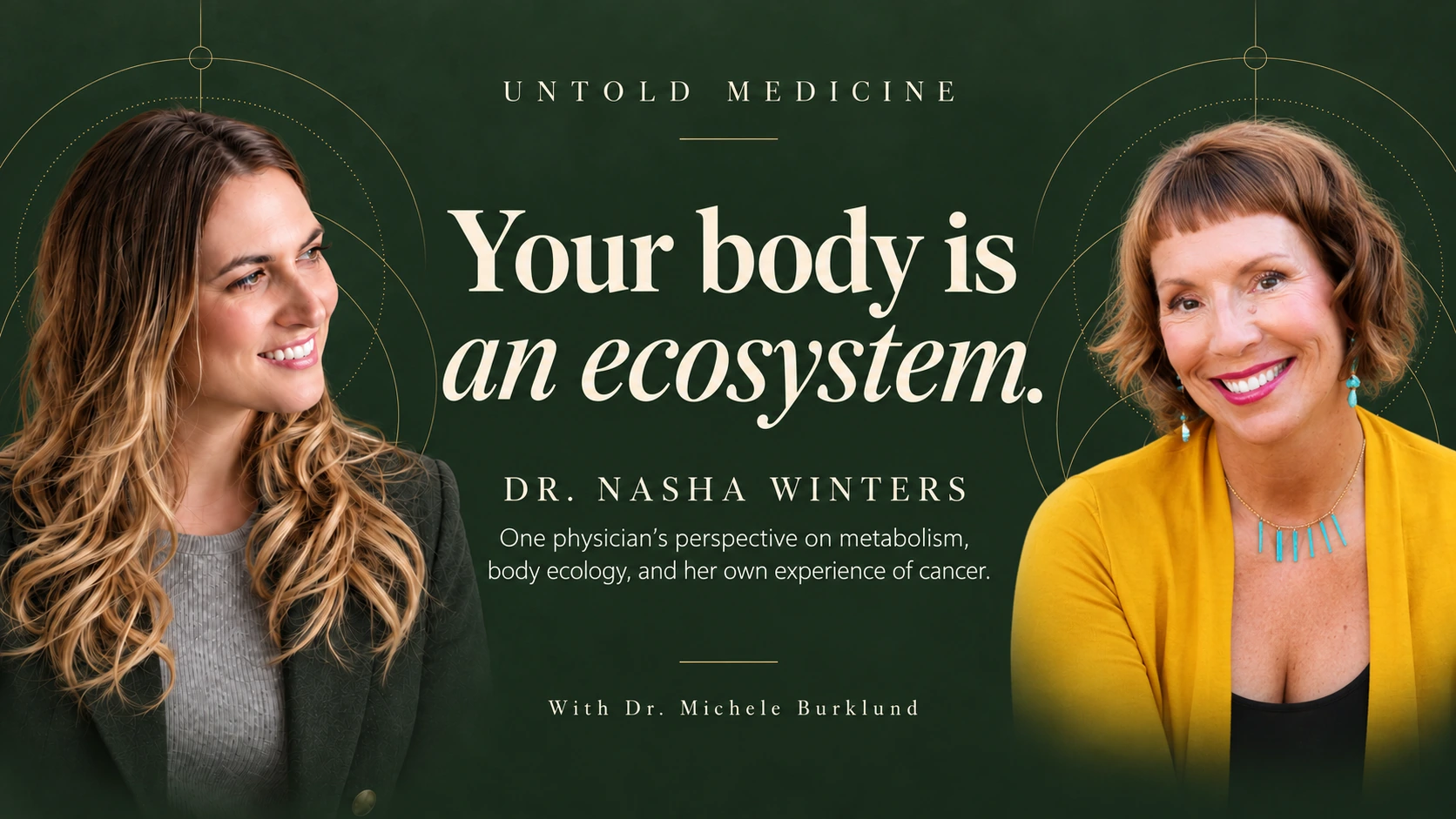
A conversation with Dr. Nasha Winters
A diagnosis can change the questions a person asks for the rest of her life. Nasha Winters joins me to reflect on her own cancer experience, the emotional landscape surrounding it, and the path that led her into integrative work. We talk about body ecology, education, and the meaning she found in becoming a physician.
The original conversation, in full. Watch on YouTube ↗
For a walk. For a quiet hour.
Inside the conversation
A guide to the ideas in this interview, in my own editorial words.
Winters recounts her experience of cancer as a young woman and the difficult circumstances that surrounded that time. I ask how those experiences shaped her later work and the questions she brings to health. Her account is an individual story; it cannot show which factor caused an outcome or predict another person’s experience.
She uses “terrain” to describe the wider context in which the body functions, discussing areas such as metabolic health, the microbiome, environmental exposures, hormones, circadian rhythms, and emotional experience. In the episode, she explains how this lens organizes her questions. It is not a personalized assessment or a cancer-treatment protocol.
Winters speaks about her own early experiences and the importance she places on emotional history. We explore how that history can shape a person’s understanding of health and care. The conversation should not be read as saying that trauma inevitably leads to cancer, or that recovery depends on having the right attitude.
We talk about her shift toward educating other practitioners and her wish to reach people through a wider professional community. She describes training, collaboration, and resources as they existed when we recorded. Listeners interested in current programs should consult her organization directly, since an archived interview cannot confirm present availability.
Stay with the words
Published automatic transcript, preserved from the original archive. Names and technical terms may contain errors. Guest views are their own; please refer to the recording for exact wording. Original transcript ↗
00:38Hi everyone, I'm Dr.
00:39Michele Burklund and welcome to
00:41the podcast Medicine Untold.
00:43Today we have Dr.
00:45Nasha Winters and I'll read a little bit about
00:49your bio right now before we get started. So, Dr.
00:53Winters is a global healthcare authority and best
00:56selling author in integrative cancer care and research
01:00consulting with physicians around the world.
01:02She has educated hundreds of professionals in the
01:06clinical use of mistletoe and has created robust
01:09educational programs for both healthcare institutions and the
01:13public on incorporating vetted integrative therapies in cancer
01:17care to enhance outcomes. Dr.
01:19Winters is currently focused on opening a comprehensive
01:23metabolic oncology hospital and research institute in the
01:26US where the best that standard of care
01:30has to offer and the most advanced integrative
01:32therapies will be offered.
01:34This facility will be a residential setting on a
01:37gorgeous campus against the backdrop of regenerative farming, EMF
01:41mitagation and a retreat, as well as a state
01:44of the art medical technology and data collection and
01:47evaluation to improve patient outcomes.
01:51Wow, that's amazing.
01:54It's a mouthful. You did.
01:56Thank you.
01:59Yeah.
02:00It sounds like an amazing vision and an
02:02amazing goal that you have right now.
02:05I'm excited to hear more about that too. Thank you.
02:10I'll get started, kind of with our first
02:12question, and that is, when you were just
02:1519 years old, you were diagnosed with stage
02:18four ovarian cancer and given months to live.
02:22So how did you feel about this?
02:24And really, what did you do differently than
02:26the doctors told you to survive this?
02:30Well, I think it's important for your listeners
02:33to know that I had a lot of
02:35health issues for many, many moons.
02:37And this sort of got, I guess,
02:39sort of lost in the shuffle.
02:42Oh, that's just more of your IBS,
02:44Oh, that's just more of your RA,
02:45Oh, that's just more of your endometriosis, your PCOS.
02:47So by the time I landed in the hospital,
02:50two weeks before my 20th birthday, near, in and
02:54out of consciousness, pulse oxygen levels extremely low, revealing
03:00that I had a complete bowel blockage, end stage
03:02organ failure, grapefruit sized tumor on my right ovary,
03:05belly filled with malignant fluid, so cancerous fluid in
03:09wrong places within my body.
03:12I know I'm missing other details of that.
03:14Excruciating pain, inability to eat, nothing coming out
03:17of either end or into either end.
03:20For weeks leading up to that hospitalization,
03:23it was that moment where there wasn't
03:25anything they could offer me.
03:27It was the end of the line.
03:29And so it was a pretty...
03:31When you talk about what did you think at the
03:33moment, I will tell your listeners that in the years
03:37leading up to that, I had actually tried to extinguish
03:39my own life on a couple of occasions.
03:41There wasn't a lot of hope on the horizon
03:43of how my life could be any different.
03:45I came from extreme trauma.
03:47If your listeners are familiar with this concept of childhood
03:50traumas and their impact on your health and well being
03:53and the way your immune system functions and your ability
03:56to ward off disease functions, you might have heard of
03:59a concept known as the ACE score.
04:01See the adverse childhood event score.
04:04Basically, if you have six or more, you are destined.
04:08Remember that these are destinies that
04:10we can rewrite our story.
04:11But from the literature, if you do nothing to
04:13rewrite your story, you will have cancer or some
04:16severe chronic illness at a very young age.
04:18So I think that was a major contributor to mine.
04:22I had a ten out of ten on that ace score.
04:25I had come from extreme poverty.
04:27I'd come from extreme malnourishment, really
04:30poor dietary lifestyle habits of just
04:32coming from that level of poverty.
04:34And no one in my family
04:36ever gone to college, nothing else.
04:37So I had a lot of things stacked against me.
04:40And so when you're in that place, as I appreciate
04:42so many people are on this planet today, I didn't
04:45see that there was a better life ahead of me.
04:48I didn't anticipate a better life ahead.
04:50So, for me, actually, cancer, there was a moment, the
04:53first moment when I was given that diagnosis that there
04:56was relief because there was sort of a way to
04:58exit strategy with a little bit of, I don't know,
05:01maybe martyrdom, maybe a little bit of, oh, that's a
05:04really good story to go out on.
05:06Oh, she died of cancer. That was like.
05:09There was a fleeting fantasy.
05:11But then this other thing happened in me, which
05:13I also recognize about myself, which I have.
05:16I actually have the OCD gene, which can be my
05:19superhero, it can be my kryptonite or my superpower.
05:22But it was that moment when
05:24someone says, it can't be done.
05:26It's like a double dog dare for me, and
05:28it's sort of like, well, then I'm going to
05:30do everything I can to prove you otherwise.
05:32So that was kind of my survival
05:35technique for all those years, too.
05:36And here we are, over 32 years later.
05:38I'm still learning about myself.
05:39I'm still applying new things to myself.
05:41I'm still learning from the tens of thousands of patients
05:43I've had direct access to support and the hundreds of
05:46thousands of patients I've had indirect ability to support and
05:50learn from and continue to basically kick this can down
05:54the road as I learn more, apply more, do more,
05:56learn more, apply more, do more.
05:58That has been my decades since mantra ever since. Wow.
06:04Yeah, I mean, it's a journey on really all levels, too.
06:08And to have that self awareness going into it, too.
06:12And knowing how your emotions played a role
06:15into this and making that choice, too.
06:17Making the choice to fight it, knowing that
06:20it was tempting for a second to go
06:22the other way and seeing all those things.
06:25I personally think that emotions play a huge
06:28role in illness and recovery is a very
06:32holistic thing that needs to be addressed.
06:34So, wow.
06:35Thank you for sharing your story.
06:37And clearly it's dictated a little bit of your path
06:40forward, too, whether you wanted it to or not, I
06:44guess, but that passion and that drive and your purpose.
06:47So how did that experience really change your life
06:51course and put you in this direction and give
06:55you the motivation to create what you have? Perfect.
06:58Well, I think there was this tendency in my
07:01own survival of being kind of the overachiever because
07:03no one on the outside world would ever know
07:05what was happening on the inside world of me.
07:06Leading up to my diagnosis, and even for the first
07:09few years beyond, I was highly accomplished in many ways.
07:12I was able to really put on a mask
07:13and present myself to the world that there was
07:16nothing wrong behind the Wizard of Oz curtain. Right.
07:19And so that was one of the things that it
07:22actually put me into hyper mode even more because I
07:25was premed, I was going to go to med.
07:27I knew what I wanted to do.
07:28So I had this very scientific, research centric brain.
07:32But I also felt very jaded and abandoned
07:38and even ridiculed by the community I so
07:41desperately wanted to be part of.
07:44And so that theme of wanting to belong was
07:49old in me and continues to this day.
07:51I mean, I'm definitely an outlier across the board,
07:53and I definitely don't fit in particular camps.
07:55I'm ridiculed in everything from the standard of care
07:58world to the naturopathic world and everything in between
08:00and beyond, because I don't fit into a box.
08:03I don't fit into something defined.
08:06So I had to define my own way, I had to define
08:08my own process, and I had to trust myself first before I
08:13allowed other people's sort of impressions of me or what can or
08:18can't be done be something I took note of.
08:22So that took me on a direction of realizing
08:24that, hey, I'm looking at stepping into an environment,
08:27a conventional medical school that absolutely no longer fits.
08:31It's what I thought I wanted, and it no longer did.
08:34So it took me on this trajectory.
08:35Suddenly I started to scramble about what? What else?
08:37Else, what else?
08:38Maybe I'll be a psychologist.
08:39Maybe I'll get into addictions counseling and
08:42trauma counseling, because that was very interesting
08:44to me because I had some understanding
08:46that was part of my illness.
08:48I also thought, well, maybe I'll just get
08:50into midwifery, because instead of facing death, maybe
08:53I can bring life into this world.
08:55That was something very interesting to me.
08:57And the other piece was there was some
09:00realization that there wasn't because there were no
09:02pharmaceutical or surgical or radiation offerings to me.
09:06There was nothing that standard care could offer.
09:09I had to get outside of that sandbox
09:11to look at things to help me along
09:12the way, which then led me to finding
09:14out about this crazy thing called naturopathic medicine.
09:18And so that was intriguing of that piece.
09:21But also in my undergrad, I was only a
09:23sophomore in college when I was diagnosed, so I
09:25still had a few more years out to get
09:27all my prereqs and all those things done.
09:30But I created a self constructed
09:32major, basically a psychoneuroimmunology major.
09:35So a biology psychology major instead of a
09:38biology chemistry major, where I brought in much
09:41more of the lion's share of the mind
09:42body component in my education and my understanding.
09:45So that was definitely a major shift from just
09:49the hardcore didactic, tangible sciences into something that expanded
09:54my worldview in a very different way.
09:57Yeah, I mean, it seems like you were forced to
10:01in so many ways if conventional medicine didn't have any
10:04answers for you and you had to seek everything yourself.
10:08I mean, it's great you had that research background a little
10:12bit at that time, and you were down that road.
10:15But I mean, still, that can be very scary to go
10:18through and to totally fend for yourself at that time.
10:23But I think that's a lot of the time.
10:25Where the answers come is through
10:27the hardship and through that journey.
10:30And so it's pretty powerful.
10:33You can relate to so many people and have
10:36that aspect of being the patient and the physician
10:40and now training physicians, too, along the way.
10:44Yeah, thank you for that. Yes.
10:49So I also know that you published a book
10:51called the Metabolic Approach, and I have seen this
10:54book almost everywhere since I started to take notice
10:58of it this year at different doctors offices, like
11:02in California and Washington here and there.
11:04And so it's been on my radar quite a bit.
11:07But for the people watching, can you tell
11:10us first, what does the metabolic approach mean
11:14in your book, if we're interested in it.
11:16We don't know anything about it, and
11:18we're new to the cancer world. Perfect.
11:21Well, a little context.
11:22So the way we understand cancer today in standard of
11:26care oncology, is that as a somatic mutation process, which
11:31is, in simple terms, a genetic disease, right.
11:35We are still pouring all of our resources
11:38into research, into resources into treatment, into resources
11:43into building new hospitals, et cetera, based around
11:47this particular idea that cancer is a genetic
11:51disease or only a genetic disease.
11:53And we've had this idea since
11:55Dr. Theodor Boveri's time in 1914, and it's picked up
11:59momentum, picked up even more momentum in the 1950s
12:03when Watson and Crick found the DNA helix, the
12:07helix that everyone's like, there's the answer.
12:10And then what?
12:10In the 80s, when we decided, well, if we can just
12:12map the genome, then we'll have all the answers there.
12:15And it's almost like every time we think this is going
12:18to be the answer, we end up with more questions, right?
12:20So that's one piece, and yet it's still
12:24the model and the philosophy and the paradigm
12:28that is leading the charge in how we
12:30think about study and approach cancer today.
12:34So keeping in mind that this is where
12:37we've been functioning from for over 100 years.
12:40Similarly, at that time, just a couple of years
12:42later, another researcher and clinician came forth saying, actually,
12:46no, cancer is not a genetic disease.
12:49Genetics might be a downstream effect, but the
12:53upstream effect is that it actually starts at
12:55the level of these little tiny organelles within
12:58our cells called the mitochondria.
13:00And your listeners might remember back to maybe
13:02their 6th grade biology classes about the mighty
13:05mitochondria and the fact that these little buggers
13:07are our little powerhouses of our cells that
13:11make energy, that make ATP.
13:13So that was where this. Dr.
13:16Otto Warburg, if your listeners want to really
13:18dive down a deep rabbit hole, go and
13:20read the book Ravenous by Sam Apple.
13:23Fascinating about this time and this research of that time in
13:26the 1920s, of which he won a Nobel Prize for this
13:28work in 1931 or 32, I always forget, but somewhere in
13:32the early 30s, he won a Nobel Prize for this finding.
13:35But what he noted is that, simply put,
13:39cancer cells, all of our cells of our
13:42body, except for red blood cells, have mitochondria.
13:45And what he noticed are cancer cells.
13:48The mitochondria within those cancer cells look very
13:51different than the mitochondria in our healthy cells.
13:53And push, come to shove, over the last
13:55hundred or so years, we've started to learn
13:58that the different shape, the different behavior, the
14:00different personality of that mitochondria, even the different
14:03number and activity of those mitochondria are what
14:06are creating of disease or preventing of disease.
14:10And so we started to realize that the
14:13way our mitochondria is expressed, how many we
14:16have, how well they're working or not working,
14:19is basically our fountain of youth.
14:22And so that is where we start to get
14:24a bigger vision than this myopic genetic approach.
14:29And so when we talk about this in
14:31the books, you have a little context.
14:32Now, this idea really was, it won all the awards.
14:36It was where everyone was putting
14:37their attention until Watson and Crick.
14:39And then it was sort of like that
14:40got buried until years later, when people started
14:43dusting off some of this information and asking
14:47different questions about it, one of which I
14:49stumbled across her research in the 1980s,
14:51Dr. Mina Bissell, who's actually presented at some of big Society
14:56of Integrative oncology conferences over the years, she started to
14:59understand that in her research in a lab, that the
15:03cancer cells were more responsive to the medium in which
15:07they were growing in that petri dish than in the
15:11cell itself, which started people to question whether cancer was
15:17really at that cellular genetic level, and that maybe we
15:20should broaden our thought process to basically look at the
15:22swimming pool in which those cells are swimming, might be
15:26of more interest.
15:26And so her work in the
15:28extracellular matrix became really paramount.
15:31And then in the mid 2010 era, people like Dr. Thomas Seyfried
15:36dusted off further and said, let's
15:39look at cancer as a metabolic derangement at
15:42that mitochondrial level where our body is using
15:46and choosing different resources to fuel the cancer
15:49versus to fuel the healthy cells.
15:51And so that is what led to this book.
15:54That even though I've been living it and practicing it
15:56in myself and patients for over 30 years, I suddenly
16:00had people that had created language for me to start
16:02to communicate and convey what it was that I was
16:05seeing and doing in the clinic.
16:07And what I started to understand after decades of my
16:09own clinical practice and my own applying it to myself.
16:12First approach was that everything we think about,
16:16put on in or around us, and even
16:19down to the people we surround ourselves by
16:22impact, the health of our mitochondria.
16:25So think about the mitochondria.
16:27We used to think it was just about power creation,
16:29but we've learned since that it's very much about a
16:32receiver of information from the environment around it, whether that's
16:36intracellularly from the tissues, from the blood flow from the
16:41organs, from the whole container of the body itself, from
16:44outside of the container of the body itself from things
16:46we're being exposed to day to day.
16:48Whatever inputs coming in, that mitochondria's job is to
16:52see it, recognize it, ingest it, translate it, and
16:56then put signals out into the body to tell
16:58the body what to do with that input.
17:01So what happens over time is that input
17:03gets congested, congealed, and mismanaged and miscommunicated, which
17:07leads to all types of weird signaling processes
17:09which can flip into a cancering process.
17:12So it's basically accumulations of life.
17:15And even to this day, standard of care
17:18has stated that cancer itself, less than 5%
17:21of all cancer, actually have genetic origin.
17:23And yet we are still treating
17:25cancer as a genetic disease.
17:27And they are completely in agreement to say that
17:2990% to 95% of our diet and our lifestyle
17:32and the world around us is actually what is
17:35impacting our cancering process or not.
17:37And yet we don't put our
17:39resources of research in there.
17:41So the book, the metabolic approach to cancer, is
17:43trying to bridge that, help people understand the why
17:47of cancer, which is to evaluate, I guess, for
17:50me, it could be for someone, maybe seven buckets.
17:53For others, it might be twelve buckets.
17:54But for me, I kind of landed on ten major
17:56buckets that seem to contribute to a mitochondria's health or
18:01disease, which then is the sort of precursor to whether
18:05this becomes cancer or other chronic illness.
18:08And so, simply put, I go into these terrain ten.
18:11Okay, so one of them is epigenetics, meaning
18:15what did you inherit from those before you?
18:17What is the blueprint that you were born with?
18:19Now, the cool thing about this blueprint is
18:21that it's not necessarily set in stone.
18:23It might be what your tendencies are, what your
18:26predispositions are, but it's how you play those tendencies,
18:30how you feed those tendencies, how you fortify yourself
18:34against those tendencies that help keep that genetic expression
18:39symbiotic in the rest of the body.
18:41All right, so that's one drop in the bucket.
18:43The other one is, what are you fueling yourself with?
18:45That's our metabolic health.
18:47So, we had, in the last 150 years, eat more
18:50sugar than ever from a variety of resources, going from
18:53about five pounds of sugar per person in the early
18:5618 hundreds to over 175 pounds per person today.
19:00Big difference.
19:00Our body couldn't adapt quick enough to that change.
19:04Right?
19:04So, wow is right.
19:06And so we now learn that sugar is
19:08the driver of a lot of metabolic diseases.
19:10Not that it's caused, but
19:11it certainly makes things worse.
19:13More inflammation, more immune suppression,
19:16more poor oxygenation, more immune
19:20dysfunction, more metabolic microbiome dysfunction.
19:24It just adds a lot of gunk to the workings internally.
19:29Then we look at environmental.
19:30At this point, we live on the planet.
19:32If you live here on this planet, you have toxicity.
19:34It's just how does it interplay with your particular blueprint
19:38and how much are you taking in and how much
19:40is your body able to take care of?
19:42And then we look at the microbiome, which is
19:44just now picking up momentum in the sciences.
19:46Despite the fact that, like ayurvedic doctors, chinese doctors,
19:50naturpaths, we've known for millennia that the gut
19:54is where it's at, where it starts.
19:55We just didn't quite have the languaging to
19:57understand that or convey that or research that.
19:59And then it gets down to our immune
20:01system, inflammation, circulation, and oxygenation of the body.
20:06Hormone like balance, not just excess
20:09or deficient, but balance of our
20:12hormones, circadian rhythm and stress response.
20:15And the mental emotional piece which we've already alluded to
20:18in the beginning of my story in all of this.
20:20And so what the metabolic approach to cancer book
20:23tries to do is help the reader get curious
20:28about what might be the big drops in their
20:30own bucket affecting their mitochondrial expression.
20:33And so even the beginning of the book has a
20:35very rudimentary quiz to see maybe what your priorities are.
20:40And then you can go in and focus on that and
20:42see, okay, maybe I'm getting too much sugar in my life.
20:44What can I do about it?
20:45Maybe I am getting too many toxins.
20:47What can I do about it?
20:48Maybe my hormones do need more modulation.
20:50What can I do about it?
20:51So it's a roadmap to help people understand where
20:54they came from, where they are in this moment,
20:56and how to get to their next desired destination.
21:00Right.
21:01And, I mean, I'm amazed at how
21:03comprehensive it is in that book, too.
21:06I was going through it the other day, and you have
21:08a lot of great questions at the beginning, I think, for
21:11people who might not think they were even exposed to toxins
21:15or certain things or grew up in a certain environment and
21:17might have never thought anything about it.
21:20And then they're reading this, and they're like, okay, I
21:22can see where it ties in, or I can. Interesting.
21:26This is an interesting question, and I
21:27can dig in it a little more.
21:29So I was very impressed with that and how you
21:31can kind of take people on a journey as well. Thank you.
21:35We've even, since then, thanks to technology, we've
21:39actually expanded on that questionnaire that's completely free
21:42to take deep dive like hundreds of questions
21:45instead of a few that really take it
21:47down, it's got a weighted score.
21:49So at the end of the questionnaire, you
21:51really know what your highest percentage is.
21:52And maybe you look at your top two or three, and
21:55that might be where you want to put your focus and
21:56work with someone who understands terrain, understands the body ecology, and
22:02how to best support it along the way.
22:04But it's still, I can't even tell
22:06you how many people at this point.
22:08The book has sold over 100,000 copies.
22:10It's in six languages, seven languages, two more coming
22:13out this year with more on the horizon.
22:15It's just accidentally seeping out there.
22:17But people tell me all the time, it's
22:20like, as you said, they didn't know what
22:21they didn't know until they knew.
22:23And I think that's what's catching us off guard today,
22:26is now that cancer statistics globally are expecting one in
22:29two of us to experience this in our lifetime.
22:32We need to be a bit more proactive to understand why.
22:36Because I can't even tell you, Dr.
22:37Michele, how many patients have said to me,
22:39but I was healthy until I got cancer.
22:42And what I have to explain to them is
22:43that was absolutely impossible, that it's not possible to
22:47be both healthy and cancer at the same time.
22:50You can be healthy with cancer
22:52where it's keeping the cancer dormant. Right.
22:56But you can't be healthy and have the cancering process,
22:59like a galloping goose going off the tracks there.
23:02That is not possible.
23:03So we always want to dig deeper, get curious as to
23:07what might make you vulnerable to your mitochondria being damaged enough
23:12to move into a realm of a cancer process.
23:16Right.
23:17And I think all of that information is so incredibly
23:20helpful, too, just to let people know and to guide
23:24them along the way of have them thinking that way.
23:27And a question for you is, so I know that
23:31you've been training physicians in this approach for a while.
23:35How would somebody who's in this, because you're not
23:38seeing patients anymore, but you're in the training phase
23:41to get that information out on a larger level
23:43now, which is amazing, which is super awesome.
23:46How would they find that?
23:47If somebody's looking for a practitioner, they
23:49want to know more about this and
23:51have somebody guide them along the way?
23:54Where would they find that information? Great question.
23:56I appreciate the opportunity to talk about something that's really
23:59fun for me, which is I really love Docere, Teacher.
24:05Doctor means Docere, which means teacher. Right.
24:07So I think we just come by
24:08this naturally by being just a doctor.
24:10But it's neat when you can actually get out
24:12there and help other doctors do reach more.
24:15So instead of me just being a one to one,
24:17one doctor to one patient, it's now me to.
24:20Currently we're at 200 clinicians, although we're
24:23expanding that next week to 40 more
24:25at jumping into our cohort of training.
24:27We're going into our 9th cohort now that's one to 240.
24:31And the reach that they each have, suddenly
24:34it's exponential, which is massive and necessary.
24:37So the metabolic Terrain Institute of Health is our 501
24:42nonprofit entity in which we house all of our education
24:46platforms, our patient grants, so patients that are seeking help
24:51in financing some of their integrative oncology treatments for clinicians
24:55in parts of the world, or even new graduates who
24:57don't have the financial resources but really want to be
25:00trained in this, we've even got grants for clinicians to
25:03take this course.
25:03We even have global pricing.
25:06So, for instance, I had a call this morning with a
25:08doctor, an oncologist in Romania, who very much wants to take
25:11this course, but the price, they can't pay it at the
25:14US dollar value because it's just not possible.
25:17So there's a particular formula you use
25:19for countries around the world that makes
25:21it applicable to their own financial system.
25:25So we want this accessible by everybody.
25:28But ultimately, at the end of the
25:29day, after this course is complete, clinicians
25:31have an opportunity to pass an exam.
25:33Some just come through for their own knowledge, some
25:36come through to just get this and say, hey,
25:38I completed it, here's my certificate, and move on.
25:41Most, however, say I'm now part of a
25:43mission and a vision much bigger than myself,
25:45and I want to continue down this.
25:46So they decide to be ongoing, they
25:48decide to stay in the network.
25:49They decide to also be
25:50teachers themselves into this community.
25:53And those folks are listed on
25:55our mtih.org website, which stands the
26:00metabolicraininstituteofealth.org website under directory, under practitioners.
26:06Those are our vetted, trusted colleagues around
26:08the globe that focus on this.
26:10We've also got another learning opportunity for people
26:13who, if they can't order labs, if they
26:16can't order imaging, if they can't prescribe, but
26:18they still have good medical background, maybe they're
26:20a nurse, maybe they're a nutritionist, a physical
26:23therapist, maybe they've got a health coaching background
26:27that want to be part of this.
26:28We have what's called our Tap program, which is
26:30our terrain advocate program, which is also a course
26:34which has our vetted graduates on there.
26:36We've got 300 of those folks in 36 countries,
26:40our fifth or 6th cohort, starting in April.
26:42So we've got that.
26:44They are the bridge between the clinician and the
26:47patient, and they're often the first line helping patients
26:50onboard into this, helping the educational process of this,
26:53helping make sure nothing falls into the cracks, helping
26:56people literally go through and audit their lives, not
26:58just their pantries about what they may be exposed
27:01to and what they can do about it.
27:03And so that's an opportunity.
27:04And then later, second quarter of 2024, we'll be
27:07dropping kind of a do it yourself course for
27:09people who just want to maybe expand upon what
27:12they learned in the book, but they're not a
27:13healthcare provider, and they really want this for themselves,
27:16to be more inspired, educated and empowered.
27:20That is, being ready to drop for everyone for
27:23kind of a do it yourself program in a
27:25couple of months, which we're also very excited about.
27:28All of this information about our educational
27:30platforms can be found on mtih.org. That's perfect.
27:35And I'll make sure to put all those
27:36links up when we publish this, too.
27:38So everyone has a place to
27:40go and to find everything as. Thank you.
27:43Huge, huge.
27:44What we've learned is that an empowered
27:46patient is a patient with better outcomes.
27:49And I know you, Dr.
27:50Michele, see that firsthand, that it's like, this
27:54is going to sound kind of crass, but
27:56an empowered patient is hard to kill.
27:58It's just the way.
28:01And I think back to Bernie Siegel, his book
28:03back from the 80s, medicine, what is it?
28:06Mind, Medicine, Miracles.
28:07I may be skewing that a little bit, but
28:09one of the earlier influencers in my own healing
28:11journey, he talked about the power of even like,
28:14support groups and these networks, and that patients that
28:17were involved in any form of supportive community with
28:21their own diagnosis had far better outcomes and overall
28:24survival rates than those who did not.
28:26So we're creating yet another communal approach for this people
28:31like James Maskell, who's a dear colleague out there in
28:35the world, he wrote a beautiful book called the Community
28:37Cure, which is talking about how medicine should go back
28:40to being a community based approach.
28:42So I feel really proud at MTIH,
28:44that's what we keep bringing to the
28:45table, that we're bringing everyone together.
28:47It shouldn't be a hierarchy of doctors over
28:49here, mid levels over here, patients over here.
28:52We all just need to be gathered around
28:53the table together to learn from one another,
28:56to inspire one another, to empower one another.
29:00Yeah, 100%.
29:02I mean, I created this whole podcast mainly to give
29:05patients back, to empower them, and to say, hey, this
29:09is a journey that you're on, and you put together
29:11your own team and you make your own choices.
29:14And I think the outcome dramatically changes once you
29:18take that responsibility instead of giving it to the
29:21team or giving it to a certain area.
29:23So huge fan of that.
29:26Cool.
29:27Well, thank you so much, Dr.
29:29Winters, for coming on today and
29:31sharing all of your amazing information.
29:33And we'll make sure that all of our listeners have
29:37access to everything you talked about today, and they can
29:40find you and find your book as well.
29:43Thank you so much.
29:44And I'm so, so happy that you're
29:46getting these types of conversations out there. So, Dr.
29:49Michele, thank you for what you do.
29:51Thank you very much.
Originally published February 18, 2024. Hosted by Dr. Michele Burklund.
Keep following the thread
Watch · Listen · Read ↗With Dr. Kristi Harter
Enter the conversation ↗ Watch · Listen · Read ↗
With Lauren Mahana
Enter the conversation ↗ Watch · Listen · Read ↗
With Dr. Catherine Clinton
Enter the conversation ↗Bring it into your everyday
Return to the essentials with The Foundations, my free audio course. Or explore the journal and the work behind these conversations.
For education and reflection. For personal health concerns, seek additional care and appropriate specialists.